Granite Slab Grades Explained: Commercial, Standard and Premium for Distributors
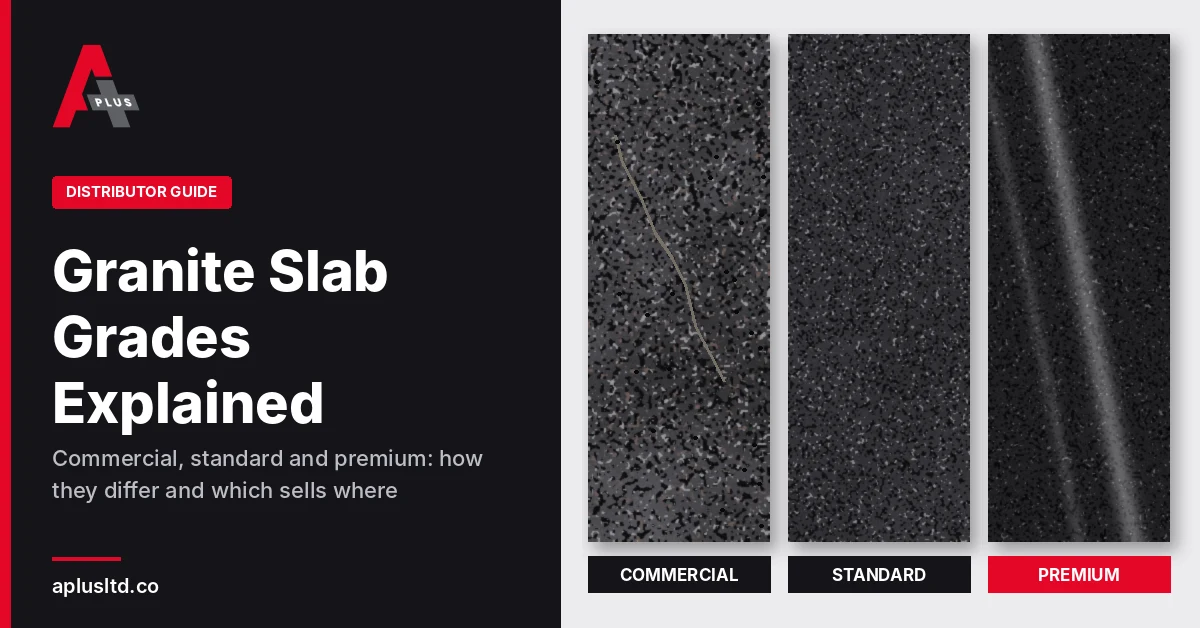
Two granite slabs can have the same name and still look worlds apart. One has an even base colour, a deep shine and clean edges. The other has small holes, filled cracks and patchy shade. Both are granite. But they sit in different grades, and they suit very different buyers.
If you sell stone in Mauritius, knowing granite slab grades is one of the best ways to guard your profit and avoid fights with buyers. Sell a top slab into a low budget job and you lose the deal on price. Sell a low grade slab into a luxury villa and the buyer may send it back. This guide shows how commercial, standard and premium grades differ, how to check them, and which grade sells best in each part of the market.
Granite slab grades tell you how good a slab looks and how well it was made. Commercial grade has the most shade change, some small holes and fills, and the lowest price. It suits low cost homes, rentals and small cut pieces. Standard grade has good, even colour and a nice shine. It is the best seller for home kitchens and floors. Premium grade has the most even colour, the fewest flaws, the best shine and the biggest slabs. It suits luxury villas, hotels and high end jobs. There is no single world rule for these grades, so always check slabs against the grade you agreed with your supplier. See our range on the granite supplier page.
What Are Granite Slab Grades?
Granite comes out of the quarry in huge blocks. These blocks are cut into slabs, then polished or given another finish. No two blocks are the same. Some parts of a quarry give clean, even stone. Other parts have more veins, shade shifts, spots or fine cracks.
After cutting, slabs are sorted by how they look and how well they were made. That sorting is what the trade calls grading.
Keep one thing in mind from the start. There is no single world rule for commercial, standard and premium granite. Each quarry, plant and seller sets its own rules. A slab one seller calls premium may be close to another seller’s standard grade. That is why smart buyers judge slabs on clear points they can check, not on the label alone.
You may also hear other names for the same idea. Some say first, second and third choice. Others say A, B and C grade. In most markets, these line up with premium, standard and commercial.
Granite Slab Grades Comparison Table
The table shows how the three grades most often compare. Exact limits change from one supplier and one stone to the next, so use this as a guide.
| Point | Commercial Grade | Standard Grade | Premium Grade |
|---|---|---|---|
| Colour match | Clear shade change between and within slabs | Good match with mild change | Very even across the whole bundle |
| Flaws | Holes, fine cracks and spots easy to see | Small marks in a few spots | Very few marks |
| Resin and repairs | Resin fill and repairs are common | Light resin | Clean, light resin |
| Shine | Fair shine, may be patchy | Good, even shine | Deep, mirror shine |
| Thickness | Can vary more | Varies a little | Tight and even |
| Slab size | Often small | Mixed sizes | Large slabs, fewer joins |
| Edges | More chips | Mostly clean | Clean and square |
| Price | Lowest | Mid range | Highest |
| Main buyer | Low budget builds, rentals, small cut pieces | Home owners, builders, mid range projects | Luxury villas, hotels, high end designers |
Commercial Grade Granite
Commercial grade is the entry level of the market. It is still real granite, just as hard and strong as the top grades. The gap is mostly in looks. These slabs come from parts of the block with more marks, or they show more signs of the cutting and polishing work.
What to expect
- Clear shade changes, at times within one slab
- Small holes on the polished face, most of all in coarse grain stone
- Fine cracks that have been filled with resin
- Smaller slabs, so long tops need more joins
- A shine that may look patchy in direct light
Where it sells
Commercial grade sells well where price comes first. In Mauritius, that means low cost homes, rental flats, staff housing, back rooms in hotels and cafes, and small cut pieces. Think window sills, steps, skirting and small bathroom tops. When the stone is cut small, most marks drop out of sight, and buyers are glad of the low price.
The main risk is what the buyer expects. Always show the real slab or clear photos before the sale. Call it commercial grade in plain words. Most fights start when a buyer expects top looks at a low price.
Standard Grade Granite
Standard grade is the backbone of most granite trade. It strikes a good balance of price and looks. It is what most home owners picture when they think of a granite kitchen.
What to expect
- Good colour match within a bundle, with mild shade change
- Small marks in a few spots, often near the edges
- Light resin to make the face stronger and the colour richer
- A smooth, even shine
- Slab sizes that fit most kitchen plans
Where it sells
Standard grade is the best seller for kitchen tops, bathroom tops, stairs and indoor floors. It suits home owners, stone workshops, builders and mid range flat and town house projects. For most sellers, this grade should make up the largest part of the stock, since it serves the widest range of buyers.
Premium Grade Granite
Premium grade is picked from the best part of the block and handled with extra care. Buyers who notice every small detail, and who are glad to pay for it, choose this grade.
What to expect
- Very even base colour and pattern across the bundle
- Very few holes, spots or fine cracks
- A deep, mirror shine
- Tight, even thickness, which makes cutting and fitting easier
- Large slabs for long islands and tops with fewer joins
- Clean, square edges with few chips
Where it sells
Premium grade fits luxury villas, beach homes, hotel lobbies and suites, high end restaurants and smart offices. It also suits jobs where a designer has set strict rules. It is the right pick for dark stone such as absolute black too. On a dark face, every scratch, hole or dull patch shows up under lights.
Top jobs often need a lot of slabs from the same block so they all match. Check you can get the full amount before you quote. Keep the block or bundle number on file in case the buyer orders more later.
What Decides the Grade of a Granite Slab
Whatever label a supplier uses, these are the points that truly decide the grade. Use them as your check list.
1. Colour and pattern match
Lay slabs from one bundle side by side. In premium grade, the base colour and pattern should flow evenly. In commercial grade, you may see clear patches of lighter or darker stone.
2. Fine cracks and real cracks
Fine cracks are natural lines in the stone. They are most often stable, and many are filled with resin. Real cracks are actual breaks. If a crack runs right through the slab, turn it down, no matter the grade.
3. Small holes
Coarse grain granite can lose tiny bits of stone while it is polished. This leaves small holes on the face. A few small holes are fine in commercial and standard grade. Premium slabs should show very few.
4. Resin
Most granite slabs today get a resin coat. It fills fine cracks, adds strength and makes the colour deeper. This is normal and not a sign of a poor slab. What counts is how clean the resin work is. Look out for cloudy patches, uneven spots or resin that has turned yellow.
5. Mesh on the back
Some slabs have a fibre glass mesh glued to the back for support. This is most common on stone with more fine cracks. Mesh is fine, but very heavy mesh can be a sign of a weak slab.
6. Shine
Look at the face from a low angle in good light. A top shine throws back a sharp, clear glow across the whole slab. Dull patches, swirl marks or a patchy shine point to a lower grade or rushed work.
7. Thickness
Measure each slab at a few points. Even thickness makes cutting faster and keeps joins flat. When thickness jumps around, the workshop spends more time and money on each job.
8. Size and edges
Big slabs are worth more because they mean fewer joins and less waste. Check the corners and edges for chips that cut down the usable area.
9. Rust spots
Some granite holds iron in it. Over time, this can leave rust coloured spots, most of all outdoors or in wet areas. Ask how the stone has held up in wet and seaside jobs before.
Seller tip: Agree the grade in writing before you order. A short note with photos of marks you will and will not accept protects you and your supplier. It also makes any claim far easier to settle if a bundle arrives below the grade you paid for.
Gangsaw Slabs vs Cutter Slabs
People often mix up grade and slab size, but they are not the same thing. Two main sizes are sold:
- Gangsaw slabs: large slabs cut from full blocks on big saws. They are used for kitchen tops, islands and wide floors where size counts.
- Cutter slabs: smaller slabs, most often with a fixed width, cut from small blocks. They are well liked for steps, floors, sills and low cost work.
Both sizes can come in any grade. A seller might keep premium gangsaw slabs for luxury kitchens and commercial grade cutter slabs for stairs in low cost housing.
Which Granite Grade Sells Where in Mauritius
Matching the grade to the buyer is how you win repeat orders. Here is a quick guide.
| Buyer or Job | Best Grade | Why |
|---|---|---|
| Low cost homes and rentals | Commercial | Price comes first and pieces are often small |
| Steps, sills and skirting | Commercial or standard | Small cut pieces hide most marks |
| Home kitchens | Standard | Good looks at a fair price |
| Mid range flats and town houses | Standard | Same look across many units |
| Stone workshops | Standard and premium | Even thickness and shine save labour |
| Luxury villas and beach homes | Premium | Buyers expect a clean, even face |
| Hotels and restaurants | Premium for guest areas, commercial for back rooms | Good image without a huge bill |
| Designer led jobs | Premium | Strict rules and close colour match |
How to Build a Smart Granite Stock
Keeping every grade in every colour locks up too much cash. Most good sellers follow a simple plan:
- Make standard grade your core. Stock the top colours, most often blacks, greys and plain tones, in standard grade.
- Keep premium in best sellers only. Hold premium stock in two or three proven colours. Order other premium stone only when a job is confirmed.
- Use commercial grade for bulk. It suits bulk buyers and small cut pieces, so stock it in colours that sell fast.
- Keep bundles together. Sell slabs from one bundle to one job so the colour matches.
- Label each bundle. Mark the grade, stone name, bundle number and thickness so nothing gets mixed up in the yard.
If your buyers also ask about other tops and floors, look at our marble range and the full stone collection for more options.
How Grade Affects Price
The price gap comes from how much good stone each block gives. A block yields only a small share of premium slabs, so those slabs cost more. Extra time spent on shine and finish adds cost too. Commercial grade costs less because more of the block makes the cut and less sorting is needed.
Colour matters a lot as well. A rare stone in commercial grade can still cost more than a common stone in premium grade. When you compare quotes, always compare the same stone, thickness, finish and grade.
Common Mistakes With Granite Grades
- Buying on the label alone: one seller’s premium may be another’s standard. Always check the slabs.
- Mixing bundles on one job: slabs from different blocks rarely match well.
- Over selling commercial grade: the wrong promise causes most complaints.
- Not checking thickness: uneven slabs raise cutting costs and leave uneven joins.
- Skipping photos before the slabs ship: clear photos of each bundle stop most fights on arrival.
Granite Slab Grades FAQs
What are the main granite slab grades?
The three main grades are commercial, standard and premium. Commercial has the most shade change and the lowest price. Standard has good, even colour for most jobs. Premium has the most even colour, the best shine and the fewest flaws.
Is there a world rule for granite grades?
No. There is no single world rule for commercial, standard and premium granite. Each quarry and seller sets its own rules. So check the slabs yourself and agree the grade in writing.
Is commercial grade granite weaker?
Most often, no. Grades are mainly about looks, such as colour match, small holes and fills. Commercial grade is just as hard as the top grades. Still, check slabs with lots of fine cracks with care.
Which granite grade is best for kitchen tops?
Standard grade is the top pick for home kitchens. It looks good at a fair price. Premium grade is the better pick for luxury kitchens and big islands, where even colour and large slabs matter most.
What do A, B and C grade granite mean?
A, B and C are just other names for grade levels. A grade most often means premium, B grade means standard and C grade means commercial. The exact meaning still depends on the seller.
Does resin mean a granite slab is low grade?
No. Most granite slabs get resin today. It fills fine cracks, adds strength and deepens the colour. How clean the resin work is matters far more than whether resin was used.
Why do some granite slabs have mesh on the back?
Mesh adds support while the slab is moved, cut and shipped. It is common on stone with fine cracks. On its own, it is not a flaw.
How do I check the shine on a granite slab?
Look at the slab from a low angle in strong light. A good shine gives a sharp, even glow across the face. Dull patches or swirl marks point to a lower grade. Some buyers also use a gloss meter for an exact reading.
What is the difference between gangsaw and cutter slabs?
Gangsaw slabs are large slabs cut from full blocks. They are used for kitchen tops and wide floors. Cutter slabs are smaller and are used for steps, floors and sills. Both can come in any grade.
Which granite grade should hotels use?
Most hotels use premium grade in guest areas such as lobbies, suites and restaurants. They use commercial or standard grade in back rooms such as kitchens and staff areas.
Why does premium granite cost more?
Each block gives only a small share of premium slabs. Those slabs also get more sorting and finish work. Less yield and more work push the price up.
Can one quarry make all three grades?
Yes. One quarry, and even one block, can give premium, standard and commercial slabs. The grade depends on how each slab looks after it is cut and polished.
How do I avoid colour mismatch on big granite jobs?
Order the full amount from one bundle or block. Keep the bundle number on file. Lay the slabs out side by side before cutting, and never mix slabs from different shipments on one surface.
Which granite grade should a seller stock most?
Most sellers make standard grade their core stock, since it serves the most buyers. Premium is best kept in a few proven colours. Commercial grade suits bulk buyers and small cut pieces.
Need Granite Slabs in the Right Grade?
A Plus Ltd supplies granite slabs to stone traders and trade buyers across Mauritius. Tell us your job, colours and grade, and we will help you pick the right stock.
View Granite Range Request a Quote WhatsApp +230 5531 3417